Dating a Nurse: Pros, Challenges and Relationship Tips
Dating a nurse can feel unpredictable because hospital and clinic schedules do not follow ordinary office hours. Night shifts, weekends, holidays, overtime, and emotionally demanding days may shape when a nurse can talk or meet. That does not make the relationship impossible, but it does reward realistic planning and direct communication.
A profession can explain part of someone's routine without defining her personality. Not every nurse is endlessly patient, naturally calm, health obsessed, or available to give medical advice at home. This guide covers the real pros and cons of dating a nurse, how to handle changing schedules, how to offer support without becoming controlling, and what professional boundaries mean.
Meet caring professionals and start a genuine conversation online
What Dating a Nurse Is Really Like

Nursing involves responsibility, teamwork, physical effort, documentation, and contact with people who may be frightened or unwell. A shift can be routine one day and unusually demanding the next. When a nurse comes home quiet, tired, or hungry, the cause may be workload rather than a problem in the relationship.
At the same time, nurses have lives outside healthcare. Your partner may want to talk about music, travel, family, films, sport, or plans that have nothing to do with work. Showing interest in her profession is thoughtful; treating her job as her entire identity is not.
The best approach is to learn her specific pattern. Ask whether she prefers a short message during a shift, when she normally sleeps after nights, and how far ahead her schedule becomes available. Two nurses can work completely different hours depending on role, employer, specialty, and location.
Pros and Cons of Dating a Nurse
Lists of nurse dating pros and cons often turn professional skills into stereotypes. A more useful comparison focuses on circumstances you may actually need to manage.
| Potential advantage | Possible challenge | What helps |
|---|---|---|
| Comfort with responsibility and practical decisions | Decision fatigue after a demanding shift | Share planning and keep post-shift choices simple |
| Experience communicating with different people | Limited emotional energy after work | Ask whether she wants conversation, quiet, or rest |
| A career with clear purpose and professional growth | Nights, weekends, holidays, and overtime | Use flexible plans and protect shared time |
| Awareness of health and safety | Others may expect free diagnosis or treatment | Respect the boundary between partner and clinician |
| Ability to stay composed in urgent situations | Stress, compassion fatigue, or burnout | Offer support without trying to become a therapist |
Advantages that can support a relationship
Many nurses develop organization, observation, teamwork, and communication skills. Those qualities can be valuable in a relationship when the individual also chooses to use them at home. A medical career may also create financial independence and a strong sense of purpose, although income and job stability vary by country and role.
A nurse may understand that difficult moments require practical action rather than panic. Still, professional composure does not mean she never needs reassurance or becomes responsible for solving every family problem.
Challenges couples should discuss early
Availability is the most obvious challenge. Your free evening may begin just as her shift starts. Weekends and public holidays may be working days, while her day off falls in the middle of the week. Fatigue can also affect how much conversation or social activity feels realistic.
Do not interpret every delayed reply as fading interest. Look at the broader pattern: does she explain her schedule, suggest another time, initiate when free, and make room for the relationship? Consistent effort matters more than constant access.
Shift Work, Night Schedules and Cancelled Plans
Dating someone who works shifts requires a different planning style. Avoid building an important occasion around a narrow time window immediately after work. Confirm plans when the rota is known, choose bookings that can be changed, and keep one simple alternative ready.
- Ask for schedule information without demanding proof of every shift.
- Plan quality time during reliable days off rather than every free hour.
- Use short messages when a full conversation is unrealistic.
- Respect daytime sleep after a night shift.
- Discuss how each person handles cancellations before frustration builds.
Flexibility should work in both directions. A nursing schedule is demanding, but one partner should not make every decision or wait indefinitely. If work repeatedly leaves no space for the relationship, discuss what minimum contact and shared time both people need.
How to Support a Nurse Without Taking Over

Support begins with a question: "What would help tonight?" The answer may be dinner, quiet, a shower, a short walk, practical help, conversation, or uninterrupted sleep. Do not assume she must describe upsetting patient situations. Confidentiality may limit what can be shared, and emotional processing does not always happen immediately.
Recognize stress without diagnosing burnout
Persistent exhaustion, detachment, sleep problems, irritability, or loss of motivation may indicate that work is becoming difficult, but a partner should not diagnose the cause. Encourage rest, boundaries, discussion with a supervisor, or professional support when needed. If distress becomes severe or safety is involved, appropriate medical help matters more than relationship advice.
Share ordinary responsibilities
Practical support can be more useful than a grand gesture. Share cooking, cleaning, errands, and planning according to each person's available time. A nurse is not automatically the household health manager, caregiver, or person responsible for remembering every appointment.
Protect her privacy and your own needs
Do not ask for patient names, photographs, or details that could violate confidentiality. At the same time, support should remain mutual. Explain your own needs calmly and choose a time when neither person is exhausted. The guide to building trust in online dating offers a useful framework for boundaries and consistency.
Dating a Male Nurse or Female Nurse
Dating a male nurse and dating a female nurse involve the same practical questions: schedule, communication, emotional energy, professional boundaries, and compatibility. Gender does not determine whether a nurse will be caring, confident, jealous, humorous, or interested in marriage.
Avoid jokes suggesting that men in nursing are surrounded by women or that female nurses exist to care for a partner. Ask what the profession means to the person and which parts of the schedule affect dating. Respect is more attractive than trying to predict character from a job title.
Dating a Nurse: Expectations vs Reality
People sometimes expect a nurse partner to be available in every emergency, remain calm in every argument, and naturally organize the household. In reality, clinical competence applies to a professional setting. At home, a nurse is an individual who may be tired, uncertain, emotional, playful, disorganized, or uninterested in discussing healthcare.
Another expectation is that an unusual schedule prevents serious dating. The reality is more practical: spontaneous evenings may be difficult, but planned breakfasts, weekday dates, shared errands, and protected days off can create meaningful time. The couple needs a rhythm that fits both people rather than copying a nine-to-five relationship.
Do not confuse medical knowledge with permission to ignore boundaries. A nurse may know how to respond to an urgent problem, but routine symptoms still belong with your own healthcare provider. Likewise, compassion at work does not mean she must absorb every frustration without receiving support in return.
Can a Nurse Date a Patient?
A nurse should not pursue a romantic or sexual relationship with a current patient. The clinical relationship contains access to private information and an imbalance of knowledge, responsibility, and vulnerability. Patient interest or consent does not automatically remove that imbalance.
Former-patient situations are not governed by one universal waiting period. Relevant factors can include local law, the nursing board's code, employer policy, the duration and nature of care, access to confidential information, future treatment, and the patient's vulnerability. Mental health and long-term care can create especially serious concerns.
The National Council of State Boards of Nursing guidance on professional boundaries explains why inappropriate involvement can lead to professional discipline. A nurse facing a real situation should consult the applicable regulator, employer, or professional adviser rather than relying on a dating article.
Dating a Nurse Online
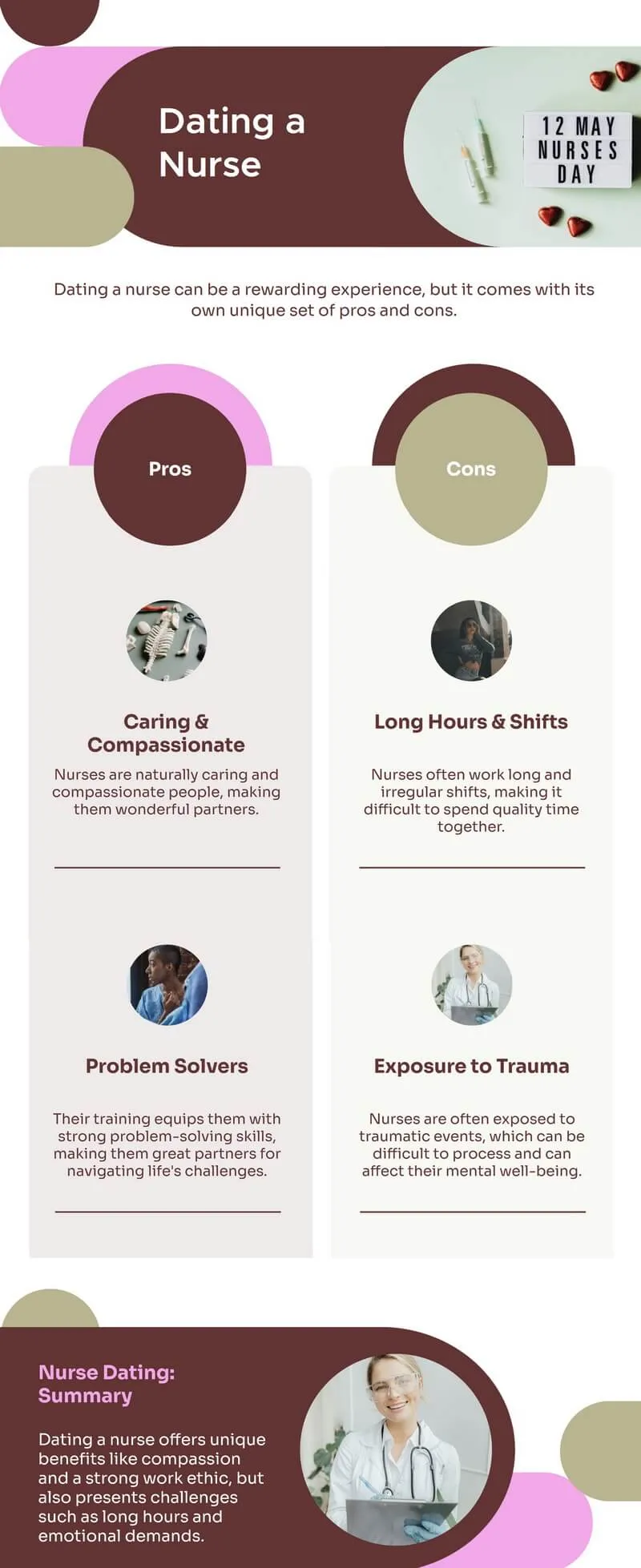
Single nurses use ordinary online dating services rather than needing a special nurse dating website. If her profile mentions healthcare, open with an interest she chose to share instead of asking for medical advice or making a uniform joke.
Use dating chat to learn her schedule and communication preferences. A delayed reply during a shift is normal; repeated one-sided effort is a separate issue. When communication becomes consistent, live video chat can reveal conversational chemistry and make planning a real date easier.
Profession should never replace basic verification. Avoid sending money, sharing sensitive documents, or assuming that scrubs and workplace photographs prove identity. Respectful video contact, consistent details, and realistic plans provide stronger evidence.
Long-distance communication with a nurse
Time zones and shifts can make international communication look irregular. Agree on a few dependable windows instead of expecting immediate replies throughout the day. Short voice notes can preserve warmth when schedules do not overlap, while planned video calls provide more depth. The guide on keeping an online conversation going offers prompts that do not depend on constant messaging.
Dating a Nurse Red Flags vs a Busy Schedule
A night shift, delayed reply, or cancelled plan is not automatically a dating red flag. The important question is whether the person communicates and repairs the disruption. A busy nurse who remains interested may explain what happened, suggest another time, and initiate contact when available.
Real warning signs concern behavior rather than occupation:
- Using the job as a permanent excuse while making no alternative plans.
- Expecting unlimited flexibility but showing none toward your commitments.
- Sharing identifiable patient information or treating confidentiality casually.
- Using professional authority to diagnose, intimidate, or control a partner.
- Repeated dishonesty about availability, relationship status, or identity.
- Pressuring you for money, private documents, or rapid commitment online.
One difficult week is not a complete pattern. Discuss the behavior clearly and watch what happens afterward. Accountability, changed behavior, and reciprocal effort distinguish a manageable problem from an unhealthy relationship dynamic.
First-Date Ideas That Work Around Nursing Shifts

A first date should be easy to confirm and easy to shorten if one person is tired. Coffee, brunch, a walk, a casual meal, a museum, or a quiet local event usually works better than a full-day plan scheduled after a long shift.
- Confirm that she is actually off rather than finishing an unpredictable shift.
- Choose a location convenient for both people, not automatically near the hospital.
- Ask about interests beyond nursing.
- Keep alcohol moderate when either person has work soon afterward.
- Suggest a second date clearly if the conversation felt mutual.
For conversation prompts, use the first-date questions guide. Afterward, the signs that a first date went well should be judged through reciprocity and follow-up, not politeness alone.
Common Myths About Dating Nurses
Nurses are always calm and endlessly caring
Professional behavior at work does not remove ordinary emotions. A nurse can be patient in one context and frustrated in another. Judge emotional maturity through communication and accountability rather than profession.
A nurse will manage your health for free
Your partner can choose to share general knowledge, but she should not be expected to diagnose symptoms, prescribe treatment, or replace your clinician. Seek appropriate medical care when you need it.
Nurses never have time for relationships
Many nurses build committed relationships and families. The practical issue is not whether time exists but how both people protect it. A difficult schedule requires planning, not a conclusion that intimacy is impossible.
Dating a nurse guarantees a stable relationship
A respected profession cannot guarantee honesty, loyalty, compatibility, or shared goals. Those qualities become visible through choices made over time, just as they do when dating anyone else.
FAQ
Is dating a nurse difficult?
Dating a nurse can require flexibility because shifts may include nights, weekends, holidays, overtime, and last-minute changes. It becomes easier when both people plan realistically, communicate about energy and availability, and avoid treating a changed shift as personal rejection.
What are the benefits of dating a nurse?
A nurse may bring communication skills, resilience, compassion, and practical problem-solving into a relationship. These are professional strengths rather than guarantees about personality, so compatibility should still be judged through the individual person's actions and values.
How do you support a nurse after a hard shift?
Ask what kind of support would help: quiet time, food, practical help, conversation, or space to sleep. Listen without demanding confidential patient details and encourage professional support when stress or burnout becomes persistent.
Can a nurse date a patient or former patient?
A nurse should not pursue a romantic relationship with a current patient. Rules involving former patients vary by jurisdiction, care history, vulnerability, and professional code. The nurse should consult the relevant nursing board, employer policy, or professional regulator rather than rely on a universal waiting period.
Where can you meet single nurses online?
Nurses use ordinary dating platforms and international dating services like other professionals. A respectful profile, flexible communication, and patience around shift work matter more than searching for a platform that promises a particular profession.
What is a good first date with a nurse?
Choose a low-pressure plan with flexible timing, such as coffee, brunch, a walk, or an early dinner. Confirm the date after the shift schedule is known and have an easy backup plan in case work runs late.
Conclusion

Dating a nurse is not a constant roller coaster, but it can involve unusual hours, fatigue, changed plans, and serious professional responsibilities. The strongest relationships respond with flexibility, shared effort, honest boundaries, and respect for the person beyond the uniform.
Learn her real schedule, ask what support means to her, and discuss your own needs as well. A profession may shape the calendar, but compatibility is built by two individuals.
Meet someone compatible and plan your first conversation today

 Start Live chat
 Send Message