Where to Meet Women in Valencia: Local Social Settings

Valencia invites people outdoors, but visibility is not the same as availability. A terrace in Ruzafa, a path through the Turia Garden, and the sand at Malvarrosa each have their own purpose and boundaries. The city's better social openings come through neighbourhood culture, sports, language practice, dance, volunteering, workshops, and food events where conversation belongs to the occasion.
Valencia is compact enough for repeated encounters yet varied enough that Ruzafa, El Carmen, Cabanyal-Canyamelar, Benimaclet, and residential districts do not share one social rhythm. This guide focuses on joining those environments respectfully. For broader national context, read about Spanish women and dating culture.
Move from a shared Valencia interest to horchata, culture, or a short plan at the right hour.
Why Valencia Rewards Familiarity More Than Cold Approaches
Valencia has university life, established local families, international residents, tourism, port activity, technology, arts, and neighbourhood associations. These communities overlap, but they do not automatically mix. A busy terrace can contain several closed friendship groups and very little openness to strangers.
Repeated participation changes that equation. When people recognise you from a workshop, running group, cultural programme, or volunteer shift, conversation has context. Both sides can observe manners and reliability before deciding whether personal interest exists.
Do not judge success only by immediate dates. New acquaintances, invitations, introductions, and knowledge of smaller events expand your real social network. That network often creates better connections than repeatedly visiting crowded tourist areas alone.
Valencia Social Activities: Choose a Sustainable Mix
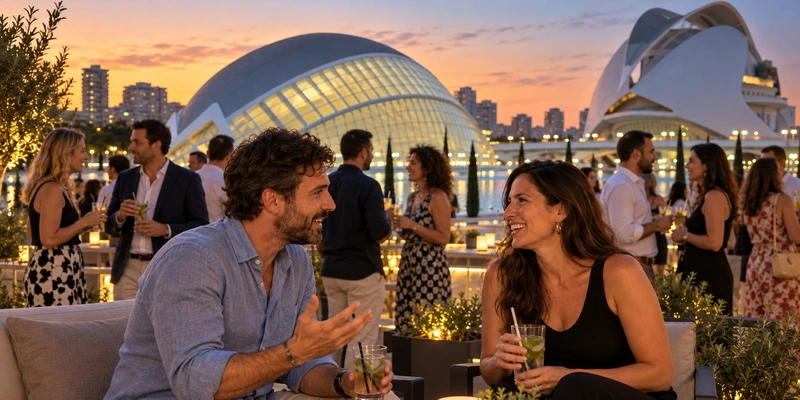
Valencia social activities work best when they fit your language, neighbourhood, transport, and weekly schedule. Combine one recurring commitment with one occasional event rather than trying a different venue every night.
| Your preference | Useful Valencia setting |
| Structured conversation | Classes, book groups, language exchange, public talks |
| Arts and culture | Municipal cultural centres, galleries, workshops, performances |
| Active routine | Turia running and cycling groups, dance, climbing, water sports |
| Neighbourhood life | Markets, associations, community programmes, volunteering |
| International circle | Professional groups, university events, organised exchanges |
Check the current organiser's calendar before attending. Programmes, access rules, and locations change, especially around holidays, summer heat, and major festivals.
1. Municipal Cultural Centres and Workshops
Valencia's municipal cultural spaces can offer workshops, theatre, music, talks, dance, reading groups, and exhibitions in different neighbourhoods. A programmed activity gives everyone a shared subject and removes the pressure of inventing an opening line.
Choose a subject you would still enjoy if no date resulted. Participate consistently, contribute to the discussion, and talk with the whole group. Someone who joins only to target women quickly makes the environment uncomfortable.
When conversation continues naturally over several sessions, a short coffee after the programme can be an appropriate next step. Ask once and make it easy to decline.
2. Ruzafa Through Culture, Food, and Repeat Visits
Ruzafa combines a traditional market with independent culture, workshops, cafes, restaurants, shops, and evening activity. Its popularity creates social energy, but popularity also brings crowds and people who simply want time with their existing friends.
Use an exhibition, workshop, performance, market activity, or recurring venue as context. Asking about the event or neighbourhood is more natural than commenting immediately on appearance. Avoid interrupting laptop work, meals, private conversations, or service staff.
Ruzafa is most useful when you return because you enjoy the area. Familiarity with a place and its programme is more credible than moving between terraces in search of strangers.
3. El Carmen Beyond Tourist Nightlife
El Carmen contains historic streets, plazas, museums, cultural institutions, restaurants, and nightlife. The concentration of activity makes meeting people possible, but tourist traffic and alcohol can make signals difficult to read.
Daytime exhibitions, guided activities, public talks, live music, and cultural programmes offer clearer interaction than circulating through late-night venues. When alcohol is involved, keep invitations simple and never treat friendliness as consent.
Respect residents using the neighbourhood as home. Noise, blocked entrances, and aggressive street approaches do not become acceptable because an area is known for leisure.
4. Cabanyal-Canyamelar Community and Coastal Culture
Cabanyal-Canyamelar has a distinct maritime history, residential streets, a public market, cultural spaces, local organisations, and access to the coast. It should not be treated as merely an extension of the beach.
Neighbourhood festivals, arts programming, food activities, volunteering, and organised coastal interests provide better social context than approaching women who are sunbathing. Learn about the area before using it as a backdrop for dating.
Public meetings near the coast can be relaxed, but identify a precise cafe, market entrance, or cultural venue. A vague suggestion to meet somewhere along the beach creates unnecessary uncertainty.
5. Turia Garden Sports and Outdoor Groups
The Turia Garden crosses much of the city and supports running, cycling, exercise, walking, and organised recreation. Its scale makes it excellent for active routines but poor for random pursuit: most people using it alone are travelling, training, or relaxing.
Join a public running club, cycling group, fitness class, photography walk, or environmental activity. Shared pacing and repeated attendance create conversation without forcing it. Do not stop someone wearing headphones or follow a runner to continue an exchange.
For an arranged first date, choose a short route with a specific meeting point and an easy exit. In hot weather, move the plan to a suitable hour or an indoor public venue.
6. Benimaclet and University-Area Communities
Benimaclet is associated with neighbourhood identity, students, cultural initiatives, music, associations, and a mix of long-term and newer residents. University districts elsewhere in the city also support talks, societies, language activities, and public events.
Age and life stage matter. A professional seeking a settled relationship should not attend student events only to pursue much younger women. Choose alumni, postgraduate, professional, or public programmes appropriate to your own situation.
Community spaces depend on trust. Learn the purpose of an association and contribute before turning any connection into a personal invitation.
7. Markets and Food Activities Without Interrupting Errands
Mercado de Ruzafa, Mercado del Cabanyal, Mercado Central, and smaller neighbourhood markets reveal local routines, but ordinary shopping is not an invitation. Busy aisles and vendor transactions offer little room for personal attention.
Use announced tastings, cooking workshops, food tours, community events, or repeated visits to a familiar stall. These formats create a shared topic and let conversation emerge naturally.
Never hold up a queue, question someone about her purchases, or follow her between stalls. If an exchange remains warm after the practical subject ends, offer a simple nearby coffee and accept the answer.
8. Dance, Music, and Creative Classes
Partner dance, ceramics, photography, drawing, theatre, music, and cooking courses can connect adults through skill and practice. They are useful because interaction is built into the activity, not because any particular class contains more women.
Observe etiquette. In partner classes, physical contact belongs to the lesson and does not signal attraction. Rotate partners when instructed, respect feedback, and avoid monopolising one participant.
A course lasting several weeks gives compatibility time to become visible. Conversation after class is a better moment for an invitation than placing someone under pressure during the activity.
9. Volunteering and Neighbourhood Associations
Environmental projects, food support, cultural festivals, animal welfare, neighbourhood initiatives, and social organisations can introduce people who care about the same issue. These settings show whether someone follows through and treats others respectfully.
The cause must remain primary. Do not pursue beneficiaries, use emotionally vulnerable situations for intimacy, or make another volunteer feel that participation comes with romantic attention.
Choose a commitment you can maintain. Reliability over several months has more social value than appearing at multiple organisations once.
10. Language Exchanges With the Right Expectations
Language exchanges can connect Valencian, Spanish, English, and international speakers. They are useful for newcomers who want conversational practice and a broader circle, but participants have not automatically agreed to be approached romantically.
Exchange languages fairly, include other people, and avoid turning every partner rotation into a request for contact details. If one conversation becomes reciprocal, ask whether she would like to continue at another public event.
Paid teachers and informal partners are not responsible for translation inside a relationship. If dating becomes serious, both people should share the effort required for clear communication.
Which Valencia Area Fits Your Social Routine?
| Area | Useful context | Important caution |
| Ruzafa | Markets, arts, food, workshops, evenings | Crowds do not guarantee openness |
| El Carmen | History, museums, music, public culture | Tourism and alcohol blur signals |
| Cabanyal-Canyamelar | Maritime culture, markets, local events | Respect residential life and beach privacy |
| Benimaclet | Associations, music, academic communities | Choose an age-appropriate setting |
| Turia Garden | Running, cycling, group recreation | Join organised activity; do not interrupt training |
| Ensanche | After-work venues, culture, food | Service and professional friendliness is not interest |
An area can help you find a suitable activity, but it cannot describe the women who live there. Avoid assigning personality, income, or relationship goals to a postcode.
Spanish and Valencian: Show Respect Without Performing
Spanish will expand everyday participation, while Valencian may be central to education, family, culture, or identity for some residents. Ask which language a person prefers instead of turning local bilingualism into an argument or a novelty.
A few sincere phrases can show effort, but memorised lines do not replace listening. If you are still learning, say so plainly and avoid expecting a woman to conduct the entire relationship in your language.
Valencia is also home to international communities. Shared English may help two people begin, yet compatibility still depends on ordinary communication, values, schedules, and future plans.
How to Start a Conversation Without Becoming Intrusive
Begin with the activity: the exhibition, class, route, speaker, market event, or volunteer task. A specific question allows a short answer and does not force someone to respond to attraction immediately.
Look for reciprocity. Does she ask something back, add a new subject, remain after the practical question is answered, or suggest continuing? Short replies, headphones, turned-away posture, renewed attention to friends, and physical distance mean the exchange should end.
Compliments are more useful after conversation begins. One clear invitation is enough; a refusal does not require explanation or negotiation.
Move From an App Match to a Public Valencia Date
A Valencia match becomes more credible when the proposal reflects the season and district. Ask about the beach activity, exhibition, dance class, food interest, or neighbourhood shown in her profile, then offer two sensible times for horchata, coffee, or a short cultural plan. In summer, avoid proposing a long walk at the hottest hour merely because the Turia looks attractive on a map.
A short coffee, exhibition, market visit, or walk near a busy cultural area keeps the first meeting manageable. Confirm the exact entrance or venue, especially in large areas such as the Turia Garden or the seafront.
Do not request private photos, financial details, identity documents, passwords, or proof of affection. If the conversation remains inconsistent, review common dating chat red flags before investing more time.
Heat, Festivals, and the Changing Valencia Calendar
Daily rhythm changes with summer heat, August holidays, university terms, neighbourhood festivals, and major city celebrations. A venue that feels social in spring may be crowded, closed, or dominated by visitors at another time.
Large festivals create energy but weak conversational continuity. Attend for genuine interest, keep plans flexible, and do not use crowds or alcohol to ignore boundaries. Check official schedules and transport changes before arranging a meeting.
Maintain at least one year-round routine. Classes, volunteering, cultural programmes, and organised sports provide steadier contact than waiting for a major event.
Common Mistakes When Meeting Women in Valencia
- Treating beaches as places where women expect to be approached.
- Relying entirely on tourist nightlife in El Carmen.
- Joining language exchanges only to collect dates.
- Assuming friendliness from hospitality staff is attraction.
- Romanticising Spanish or Valencian women as one personality type.
- Ignoring midday heat, transport, or the other person's neighbourhood.
- Continuing after short answers, refusal, or visible discomfort.
Valencia's relaxed public life does not remove personal boundaries. Warmth becomes meaningful only when interest is mutual.
Compare Valencia With Madrid and Barcelona
Valencia offers a more compact coastal rhythm than Madrid and less international-tourist intensity than central Barcelona, but each city contains many different social circles. Choose according to where you can build a real routine rather than which city appears easiest.
For a larger inland market, see where to meet women in Madrid. For dense neighbourhood culture and a larger international population, compare where to meet women in Barcelona.
Men considering relationships outside Spain can use the guide to international dating for Spanish men. International dating should reflect genuine cross-cultural interest, not frustration with local women.
Frequently Asked Questions About Meeting Women in Valencia
Where can you meet single women in Valencia?
Recurring classes, municipal cultural programmes, sports groups, volunteering, language exchanges, markets, arts events, and neighbourhood activities provide useful social settings. Ruzafa, El Carmen, Cabanyal-Canyamelar, Benimaclet, and the Turia Garden each support a different kind of routine.
Is Ruzafa a good place to meet women?
Ruzafa has markets, cultural spaces, workshops, cafes, restaurants, and evening activity. It works best when you attend a specific event or become familiar with a place, rather than interrupting women who are eating, working, or spending time with friends.
Do you need Spanish to date in Valencia?
Spanish makes local participation much easier. Valencian is also important to many residents, although individual language preferences vary. Basic effort is useful, but never assume that a woman should speak English or provide free language practice.
Are Valencia beaches good places to approach women?
Beaches are public leisure spaces, not dating venues. Group sports, organised activities, classes, and public events near the coast create better context. Do not interrupt someone who is resting, swimming, exercising, or clearly seeking privacy.
Are dating apps useful in Valencia?
Yes. They can clarify that both people are open to dating. After a reciprocal conversation, suggest a short public meeting with a precise place and time instead of maintaining indefinite chat or proposing an isolated beach meeting.
What is the best season for meeting people in Valencia?
Every season offers opportunities, but the rhythm changes with heat, holidays, festivals, and university calendars. Choose recurring indoor and outdoor activities you can maintain instead of depending on one crowded seasonal event.
Become Part of Valencia Before Looking for a Shortcut
Design a Valencia week around the hours the city actually keeps. An early-evening class, a cooler-morning sports group, or a neighbourhood programme may be more sustainable than depending on late nights and major festivals. Keep at least one activity that continues after the tourist season changes.
When a familiar person starts seeking you out, move from the group to a modest plan: horchata, coffee, a short exhibition, or a shaded walk with a precise meeting point. That invitation feels connected to local life and gives both people room to decide whether the exchange should grow.
Let Valencia provide the setting; let equal curiosity decide whether it becomes a date.