Dating Chat Red Flags You Should Not Ignore
Dating chat red flags are repeated behaviors that suggest manipulation, fraud, coercion, or an unwillingness to build a verifiable relationship. They are different from an awkward sentence, a delayed reply, or a cultural misunderstanding. The safest approach is to judge patterns: what the person says, whether details remain consistent, how they react to boundaries, and whether communication can progress naturally from text to real-time contact.
This guide covers 14 online dating chat red flags, including love bombing, financial requests, video avoidance, suspicious links, and pressure for private information. It also explains warning patterns aimed at men, texting-specific signals, and the practical response when several concerns appear together.
Start conversations with verified profiles and keep control of your pace
What Counts as a Red Flag in Online Chat?

A red flag is a reason to slow down, verify, or protect yourself. It is not automatic proof that a profile is fake. Translation can alter tone, time zones can delay replies, and a cautious person may need time before video. Concern increases when several red flags when chatting online reinforce one another, especially when emotional urgency is combined with money, secrecy, contradictions, or pressure.
| Level | Typical pattern | Reasonable response |
|---|---|---|
| Low concern | One late reply, wording mistake, shy answer, or changed plan | Ask calmly and allow context. |
| Moderate concern | Repeated inconsistencies, video avoidance, or pressure for personal details | Slow down and verify safely. |
| High concern | Money, threats, coercion, account access, or suspicious downloads | Stop, preserve evidence, and report. |
Context changes the level of risk. A request to exchange phone numbers after several consistent video calls is different from the same request in the opening message. A cancelled call can be normal; repeated cancellations combined with changing identity details and financial urgency are not. Record what happened in plain terms before deciding, because emotional intensity can make separate warning signs harder to see together.
Use the complete pattern rather than one isolated message. If you are uncertain about identity, read how to verify a dating profile without turning a genuine conversation into an interrogation.
14 Dating Chat Red Flags to Watch Out For
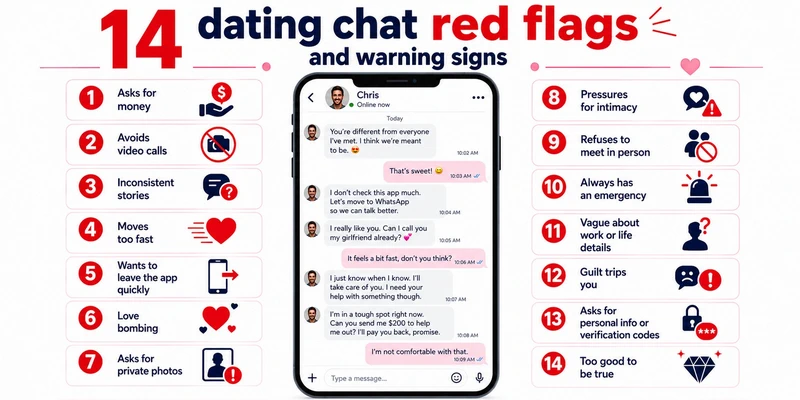
If you ask what's the biggest red flag in dating, financial manipulation and coercion require the fastest response. Other warning signs become serious through repetition or combination. The following list separates the patterns so you can identify what is actually happening.
1. Love Bombing in Early Messages
Warm interest can develop quickly, but declarations of destiny, marriage, or exclusive love after a few messages deserve caution. Love bombing creates emotional responsibility before real knowledge exists. It may include constant praise, demands for immediate exclusivity, and distress when you slow the pace. Healthy interest tolerates questions, time, and boundaries.
Fast intensity is not always deliberate manipulation. A recent breakup can also make someone seek closeness or validation too quickly. Compare the broader rebound dating signs before deciding what the behavior means.
2. Pushing to Move Off-Platform Fast
Moving to another communication method is not inherently unsafe after trust develops. The warning is urgency: a new contact insists immediately, refuses to continue on the dating platform, or claims moderation must be avoided. Staying on-platform early gives both people time to establish normal communication and access reporting tools if something goes wrong.
3. Refusing to Video Call
Privacy, anxiety, language confidence, technology, and time zones can delay video. Concern rises when every reasonable call is cancelled for weeks or months, voice is also impossible, and no alternative is suggested while emotional commitment grows. Video is not perfect identity verification, but repeated real-time conversations provide useful context before travel or financial decisions.
4. Asking for Money or Gift Cards
Do not send bank transfers, cryptocurrency, gift cards, account credentials, or payment codes to someone you only know online. Stories may involve illness, rent, travel, customs, legal trouble, or a frozen account. The FTC romance-scam guidance warns that scammers often build trust before requesting hard-to-reverse payments.
5. Her Story Changes When You Ask Normal Questions
Minor inconsistencies happen, especially across languages. Focus on meaningful contradictions involving age, location, work, family status, relationship history, or identity. Ask neutrally whether you misunderstood. A genuine mistake is usually explained directly; repeated deflection, anger, or a different version each time is more concerning.
6. Messages Feel Copied or Unrelated
Generic affection can be sent to anyone. Watch for replies that ignore your questions, repeat identical phrases, use the wrong name, or describe events that do not fit the conversation. Translation may create formal wording, so test context instead of grammar: ask about a specific detail she previously shared and see whether the answer connects naturally.
7. Every Conversation Becomes an Emergency
Real life includes problems, but repeated crises can prevent reflection. One emergency follows another, each needs immediate action, and asking questions is framed as betrayal. Urgency is especially dangerous when attached to money, travel payments, private documents, account access, or secrecy. Slow down precisely when someone says there is no time to think.

8. Investment or Cryptocurrency Advice Appears
A romantic conversation should not turn into an investment channel. Be cautious when a new match promotes a trading platform, wallet, financial mentor, or guaranteed return. Never install remote-access software, share a financial screen, transfer assets, or let someone guide transactions. Romantic interest does not make an unverified opportunity safer.
9. She Requests Sensitive Information
Passwords, verification codes, banking details, passport scans, tax numbers, work credentials, and security answers are not relationship-building material. Also protect combinations of data such as your exact address, birth date, employer, family names, and travel dates. Share personal information gradually and only when there is a legitimate need.
10. Sexual Pressure or Requests for Private Material
Flirting should remain mutual. Repeated sexual pressure, demands for intimate images, threats to leave, or ignoring a clear no violate boundaries. Images can be copied, manipulated, or used for extortion. If someone threatens exposure, stop negotiating, preserve the messages, report the account, and seek appropriate local assistance.
11. Unrealistic Travel or Marriage Plans Appear Too Soon
International dating naturally includes travel and future-location questions. The red flag is disproportionate certainty: relocation demands, tickets, or marriage plans appear before regular calls, serious discussion, or an in-person meeting. Future plans should become specific as trust and evidence grow. Early fantasy is not a substitute for practical compatibility.
12. Isolation and Secrecy Replace Normal Privacy
Manipulative communication may encourage you to hide the relationship, distrust friends who raise concerns, or make decisions without independent advice. Privacy is normal; isolation is different. A healthy partner does not need complete control over whom you consult, how quickly you decide, or whether you verify legal and financial information independently.
13. Suspicious Links, Files, or Login Requests
Do not open unfamiliar attachments, install applications, scan unknown QR codes, or enter credentials through a link sent by a new match. A page may imitate a dating service, delivery company, bank, or travel provider. Navigate to official services independently and never share one-time security codes, even if the request sounds routine.
14. She Punishes Reasonable Boundaries
A boundary such as “I do not send money,” “I want to stay on the platform,” or “I need video before travel” is reasonable. Disappointment can be discussed; guilt, threats, insults, silent punishment, or escalating pressure are warning signs. A respectful person may disagree but does not require fear or emotional punishment to obtain compliance.
Dating Chat Red Flags for Guys

Dating chat red flags for guys often exploit a man's wish to be protective, generous, successful, or decisive. A manipulator may frame financial caution as weakness, suggest that other men are competing for her attention, or demand an expensive gesture as proof of seriousness. Another pattern is accelerated responsibility: you are expected to solve housing, travel, medical, visa, or family problems before you have met.
Patterns That Target Men Specifically
Watch for praise focused mainly on income or nationality, pressure to demonstrate status, sexual material followed by threats, investment coaching, and stories designed to trigger rescue behavior. Do not let embarrassment prevent you from contacting support. The same principles covered in online dating safety tips for women protect men too: verify gradually, keep finances private, and involve an independent perspective before major decisions.
Competition is another pressure tactic. A match may claim that several wealthy men are ready to pay for travel or gifts, so you must act immediately to keep her attention. A genuine connection does not require an auction. Avoid increasing spending because you have already invested time or credits; previous effort is not evidence that the next request is safe.
You can also review how LadaDate verifies member profiles and what verification can and cannot prove. Verification reduces some uncertainty, but compatibility and trust still require time.
Online Dating Red Flags in Texting
Online dating red flags texting are easiest to recognize when you compare messages across time. One unusual sentence proves little. Repeated patterns such as unanswered questions, abrupt emotional escalation, copied wording, contradictions, and constant urgency offer stronger evidence. A search such as online dating red flags texting female may focus on women, but these warning behaviors are not gender-specific.
Texting-Specific Warning Signs
- Replies repeatedly ignore the question and redirect toward affection, money, or urgency.
- The name, city, job, or family details change without a clear explanation.
- Messages arrive in highly polished blocks but ordinary follow-up questions receive vague answers.
- Every pause triggers guilt, accusations, or demands for constant availability.
- Links, files, payment instructions, or investment screenshots replace normal conversation.
Message timing can add context but should not be judged mechanically. Work, sleep, travel, and time zones create natural gaps. More concerning patterns include a person who appears only when requesting help, disappears whenever verification is mentioned, or sends emotionally intense messages on a rigid schedule while showing little memory of your replies. Look at conversational continuity rather than response speed alone.
These are common red flags in online dating messages, but translation errors are not automatically deception. Ask a short clarifying question and judge whether the answer resolves the issue. Genuine communication becomes more specific and reciprocal over time.
What to Do When You Spot a Dating Red Flag

- Pause the risky action. Do not send money, documents, intimate images, credentials, or travel payments while uncertain.
- Review the pattern. Separate one awkward message from repeated contradiction, urgency, or coercion.
- Ask one clear question. Give a reasonable misunderstanding a chance to be explained without revealing more private data.
- Verify safely. Compare profile details and use mutually agreed real-time communication.
- Preserve evidence. Save relevant messages, usernames, links, and transaction details.
- Contact platform support. Report suspected fraud, threats, coercion, or prohibited behavior.
- Leave when necessary. You do not owe continued access to someone who repeatedly ignores boundaries.
If money was transferred, contact the bank, card issuer, payment service, gift-card company, or cryptocurrency exchange as quickly as possible and ask whether the transaction can be stopped or flagged. Do not pay a second person who promises recovery for an upfront fee. If intimate material or threats are involved, preserve evidence without continuing the negotiation and use the appropriate platform and local reporting channels.
After a report, secure any account that may be affected: change unique passwords through the official site, enable multi-factor authentication, and contact the payment provider quickly if money was sent. If the concern is resolved and communication remains respectful, continue slowly rather than demanding invasive proof.
Short labels such as LTR, FWB, NSA, or ENM describe intentions, not character. Use the dating abbreviations guide to translate unfamiliar profile language before deciding whether it represents a mismatch or an actual warning sign.
FAQ: Dating Chat Red Flags
What is a red flag when chatting with someone online?
A red flag is a behavior that suggests manipulation, deception, coercion, or unsafe pressure. Examples include money requests, contradictory identity details, suspicious links, immediate declarations of love, and anger when you set reasonable boundaries. One awkward message may have an innocent explanation; repeated patterns deserve action.
What are some red flags in online dating messages?
Common signs include copied replies, unanswered questions, changing personal stories, urgent emergencies, requests for gift cards or cryptocurrency, pressure for intimate material, and refusal of every video option while commitment escalates. Evaluate several messages together instead of relying on wording alone.
What is the 3-6-9 rule in dating?
What is the 3 6 9 rule in dating? It is a loose social-media timeline: roughly the first three months emphasize discovery, months three to six reveal adjustment and conflict patterns, and months six to nine support a longer-term decision. It is not a scientific law or a reason to ignore red flags before a milestone.
What should you do if you notice dating chat red flags?
Slow down, stop financial and personal disclosures, keep relevant messages, verify only through safe methods, and contact platform support. End the conversation when manipulation, threats, serious contradictions, or ignored boundaries continue.
Safe dating chat has progress without pressure. Both people contribute, stories remain coherent, boundaries are respected, and text can gradually move toward video or a realistic meeting. When you are ready to start again, browse verified women profiles on LadaDate and keep the same healthy standards from the first message.
Meet women online and build trust without ignoring warning signs

 Start Live chat
 Send Message