K-1 Fiance Visa vs CR-1 Spouse Visa: Key Differences

Choosing between a K-1 fiance visa and a CR-1 spouse visa is not simply a question of which form looks easier. The routes begin at different relationship stages and lead to different practical experiences after the foreign partner arrives in the United States. The right comparison starts with one personal decision: will you marry before immigration processing or marry in the United States after a K-1 entry?
This guide compares the K1 visa vs CR1 route by eligibility, marriage timing, immigration status, work and travel planning, evidence, expenses, and common risks. It provides general educational information, not legal advice. Immigration rules, fees, forms, and processing times can change, so verify every requirement with official U.S. government sources before filing.
A visa route should follow a genuine relationship that has already developed through consistent communication and real meetings. Couples still evaluating their future can first review long-distance relationships for American men; men focused on Ukraine can also start from Ukrainian brides profiles before discussing marriage, relocation, and the responsibilities that follow.
Build a serious international connection before planning the next step
K-1 vs CR-1 at a Glance
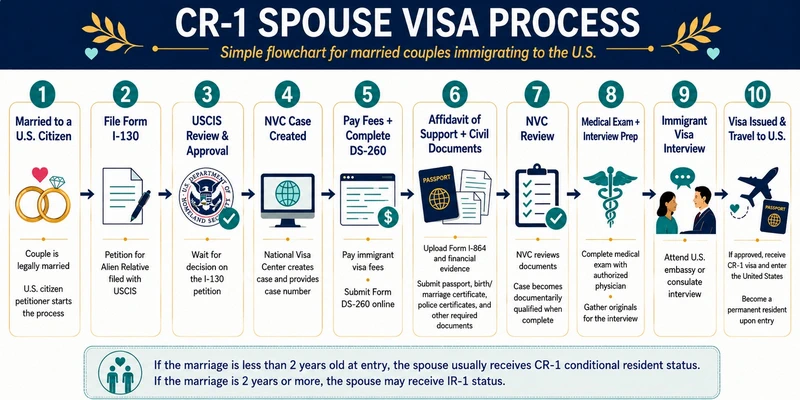
The K-1 is a nonimmigrant fiance visa. The CR-1 is an immigrant spouse visa for a marriage that is less than two years old when permanent residence is granted; an eligible spouse in a marriage of at least two years generally receives the IR-1 category instead. This distinction affects what happens both before and after arrival.
In a practical fiance vs spouse comparison, the K-1 brings an engaged partner to marry in the United States, while CR-1 processing begins after a legal marriage.
| Question | K-1 fiance visa | CR-1 spouse visa |
| Relationship status when filing | The couple is engaged and legally free to marry. | The couple is already legally married. |
| Starting petition | Form I-129F filed by a U.S. citizen. | Form I-130 filed for a qualifying spouse. |
| Where marriage happens | In the United States within 90 days after K-1 admission. | Before immigrant visa processing is completed. |
| Status at U.S. entry | Nonimmigrant fiance or fiancee who must marry the petitioner and apply for adjustment of status. | Immigrant spouse who is admitted as a lawful permanent resident. |
| Post-entry immigration step | Marriage followed by a separate green card application. | No adjustment-of-status application is normally needed after immigrant admission. |
| Practical fit | Couples who are not married and specifically want the wedding in the United States. | Couples ready to marry before the foreign spouse immigrates. |
What Is a K-1 Fiance Visa?
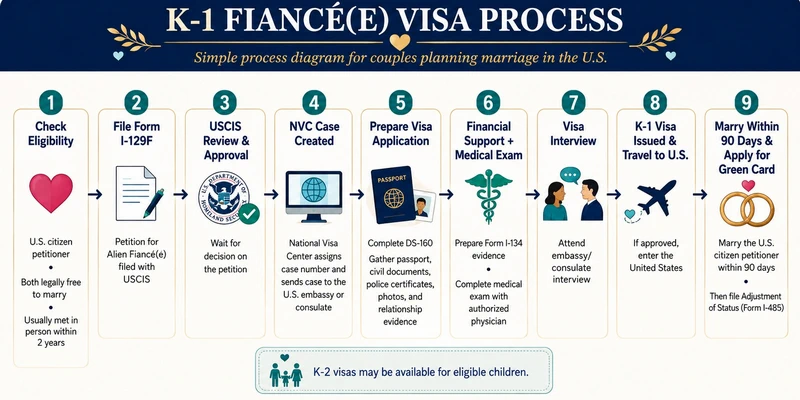
The K-1 allows the foreign-citizen fiance or fiancee of a U.S. citizen to travel to the United States for marriage. The U.S. citizen starts the process with USCIS Form I-129F. Both partners must be legally free to marry and have a genuine intention to marry each other within 90 days after the foreign partner is admitted in K-1 status.
In general, the couple must also have met in person during the two years before filing. USCIS recognizes limited exceptions involving extreme hardship or strict, long-established cultural or social practices, but couples should not assume an exception applies without reviewing the official requirements.
The K-1 visa is not a green card. After the wedding, the foreign spouse generally files for adjustment of status, which creates another application stage with its own evidence, fees, processing, and possible work or travel authorization considerations. Our broader K-1 fiance visa guide explains that process in more detail.
What Is a CR-1 (and IR-1) Spouse Visa?
The CR-1 and IR-1 are immigrant visa categories for spouses. The process generally begins with USCIS Form I-130, followed by immigrant visa processing after petition approval. Unlike the K-1 route, the couple must already be legally married.
A spouse admitted in the CR-1 or IR-1 category enters the United States as a lawful permanent resident. If the marriage is less than two years old when permanent residence is granted, the residence is normally conditional, and the couple later addresses removal of conditions. If the marriage has reached the relevant two-year point, the immigrant spouse generally enters in the IR-1 category.
Being married is not enough by itself. The petitioner and beneficiary still need to establish that the marriage is legally valid and was entered in good faith rather than primarily for an immigration benefit.
Relationship Evidence for Both Routes
Both pathways require a real relationship, but the evidence may reflect different stages. A K-1 case typically shows courtship, in-person meetings, ongoing communication, and mutual plans to marry. A spouse case can also include proof of the wedding and evidence that the couple has combined parts of life where realistically possible.
| Evidence type | Useful examples |
| In-person history | Passport stamps, tickets, accommodation records, dated photographs, and receipts from shared activities. |
| Ongoing communication | Representative message records, call logs, video-call history, and correspondence across the relationship timeline. |
| Knowledge of each other's lives | Contact with family and friends, shared celebrations, and evidence of ordinary involvement rather than only romantic statements. |
| Marriage plans or married life | Wedding arrangements for K-1 cases; a marriage certificate and relevant shared responsibilities for spouse cases. |
| Future plans | Credible discussions about housing, work, language, finances, children, and relocation. |
K-1 or CR-1: Decision Checklist
If you are asking which is better fiance visa or spouse visa, use the questions below to identify the route that matches your legal status and real-life plans.
| Ask yourselves | Why it matters |
| Are we already legally married? | An already-married couple cannot use the K-1 fiance route. |
| Where do we genuinely want to marry? | K-1 plans marriage after U.S. entry; CR-1 processing follows an existing marriage. |
| Can we manage another application stage after arrival? | K-1 normally requires adjustment of status after marriage. |
| How important is immediate resident status? | A CR-1 or IR-1 spouse enters as a lawful permanent resident. |
| Can we document meetings and a consistent relationship? | Both paths require credible evidence, while K-1 generally has a specific recent in-person meeting requirement. |
| Are there legal complications? | Prior immigration issues, criminal history, children, or earlier petitions may justify professional advice before selecting a route. |
| Have we compared every stage of cost and waiting? | The first petition alone does not reveal the total burden of either path. |
Write down both partners' answers separately, then compare them. Disagreement about the wedding, work, location, money, or family involvement is not solved by choosing a visa form.
Marriage Timing Is the First Decision
A K1 visa vs marriage visa decision begins with whether the couple is ready to marry before immigration or specifically wants to marry after K-1 entry.
A K-1 makes sense only when both people are unmarried and intend to marry after the foreign partner enters the United States. The couple should be comfortable with the 90-day deadline and should have already discussed the wedding, living arrangements, finances, family expectations, and what happens immediately after marriage.
A CR-1 route requires marriage first. That marriage may take place in the foreign partner's country, the United States during a lawful visit when appropriate, or another jurisdiction, provided it is legally valid and the couple follows immigration law honestly. A visit should never be misrepresented to border or consular officials.
If the relationship has not yet reached a confident marriage decision, paperwork should wait. A well-planned first trip to meet a foreign girlfriend from the USA is meant to test everyday compatibility, not to create pressure for an immediate proposal.
Costs: Compare the Whole Route
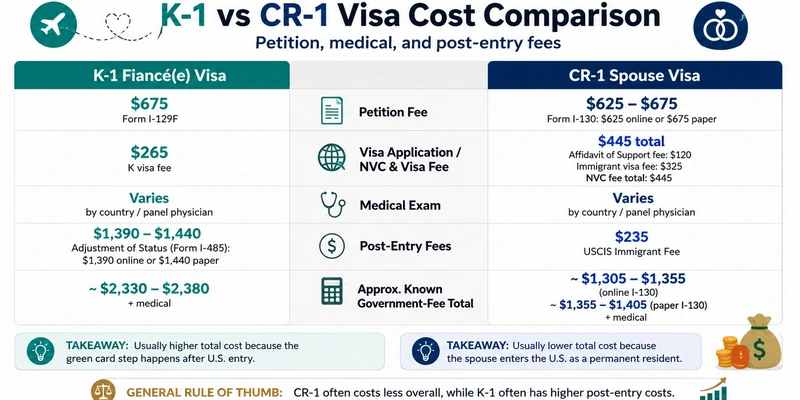
A complete fiance visa vs spouse visa cost comparison must include every government and practical stage, not only the opening petition.
Couples often compare only the first filing fee, which gives an incomplete picture. A K-1 route may involve the petition, visa processing, medical examination, travel, marriage, adjustment of status, and related applications after arrival. A CR-1 route generally concentrates more immigration processing before entry, including the petition, National Visa Center stage, immigrant visa application, financial documentation, medical examination, and immigrant fee.
Government charges change. Use the current USCIS fee schedule and the Department of State instructions for the embassy or consulate handling the case. Also budget for translations, certified records, medical requirements, travel, courier services, and time away from work.
Immigration expenses are only part of an international relationship budget. The guide to international dating costs for American men helps separate communication, visits, and relocation planning so one emotional decision does not destabilize the couple financially.
Processing Time: Avoid Fixed Promises
Search results for K1 vs CR1 visa timelines become outdated quickly, so use current agency tools for the forms and post involved in your case.
It is tempting to choose a visa by an old timeline from a forum or a friend's case. That can be misleading. Processing moves through several organizations, and a delay at USCIS, the National Visa Center, an embassy, a medical provider, or document collection can change the total journey.
Compare current official estimates for the exact petition and office, then allow room for requests for evidence, interview availability, administrative processing, and personal document delays. A cleaner case can still take longer than expected, while a published estimate is not a guaranteed completion date.
Status, Work, and Travel After Entry
The biggest practical difference often appears after arrival. A K-1 entrant has been admitted to marry the specific U.S. citizen petitioner. Marriage must occur within 90 days, and permanent residence requires the later adjustment-of-status process. Employment and international travel can depend on separate authorization and pending applications, so couples need a realistic plan for the first months.
A CR-1 or IR-1 spouse is admitted as a lawful permanent resident. This usually provides a more settled immigration position at entry, although the physical green card and Social Security administration can still involve practical waiting or follow-up.
Before choosing, discuss whether the foreign partner can tolerate a period of limited independence after K-1 entry. Consider employment, professional licensing, driving, banking, health insurance, return travel for family emergencies, and the emotional effect of depending on one partner during adjustment.
Documents Couples Commonly Need
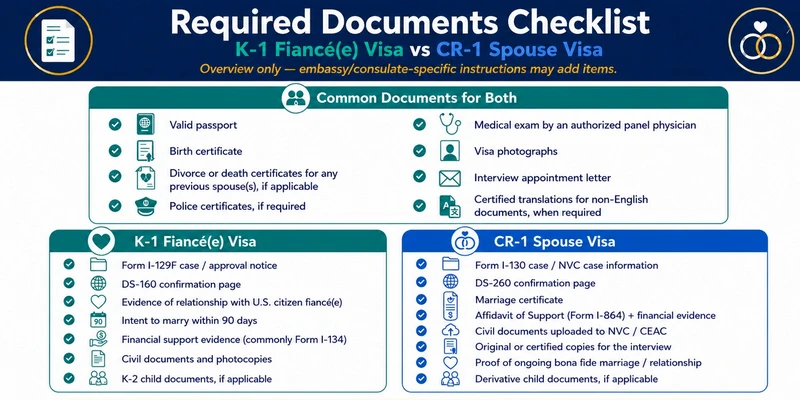
Exact document lists differ by route and case, but preparation usually includes identity, civil, relationship, and financial records. Obtain official instructions for the current stage rather than relying on a generic checklist.
- Valid passports and appropriate photographs.
- Birth certificates and certified translations when required.
- Divorce decrees, annulments, or death certificates ending prior marriages.
- Police certificates and court records where applicable.
- Evidence of meetings, communication, and a bona fide relationship.
- Medical examination and vaccination documentation from an authorized provider.
- Financial sponsorship forms and supporting tax or income records.
- Marriage certificate for a CR-1 or IR-1 case.
Names, dates, addresses, and relationship history should remain consistent across forms and supporting records. If something changed or an earlier answer was inaccurate, explain it truthfully rather than trying to hide the inconsistency.
Financial Sponsorship Is More Than a Form
Both routes involve financial evidence, though the forms and legal stages differ. The petitioner should understand current income requirements, household-size calculations, tax documentation, joint-sponsor rules where available, and the obligations attached to an affidavit of support.
Couples should also discuss their private budget openly. Immigration can create a period when one person earns less or cannot work immediately. Housing, insurance, transport, language learning, credential recognition, and emergency savings should be discussed before arrival, not after the first financial conflict.
Children and Previous Relationships
Children can change both the immigration and family plan. Eligible unmarried children may have derivative options depending on the route and age, but custody, consent to relocate, school timing, the child's relationship with the new household, and differences between K-2 and spouse-based processing require careful review.
Previous marriages also need complete documentation. Prior visa petitions, divorce timing, support obligations, criminal history, protective orders, or past immigration violations can create legal or evidentiary issues. These are areas where individual advice from a qualified U.S. immigration attorney may be especially valuable.
K-1 Visa and Current Immigration Policy
Policy and consular procedures can change while a case is pending. Effective March 30, 2026, the Department of State expanded online-presence review to K-1, K-2, and K-3 applicants and instructed affected applicants to set social-media profiles to public or open for vetting. Read the current Department of State screening notice and the instructions from the specific embassy before an interview.
Executive actions affect cases only through current law, implementing rules, agency guidance, court orders, screening, and consular operations. Verify USCIS and State Department notices rather than older summaries.
When the K-1 Route May Fit
The K-1 may align with a couple's plans when they are not yet married, the petitioner is a U.S. citizen, both are legally free to marry, they want the legal wedding in the United States, and they understand that immigration work continues after the ceremony.
- The couple wants close family or practical arrangements in the United States to shape the wedding.
- They can meet the in-person relationship requirement or have a legally supportable exception.
- They are prepared to marry within 90 days after admission.
- They have budgeted for adjustment of status and the transition after arrival.
- The foreign partner understands possible work and travel constraints while later applications are pending.
These factors do not establish legal eligibility by themselves. They simply show why an engaged couple might explore the route.
When the CR-1 Route May Fit
The CR-1 or IR-1 route may align better when the couple is ready to marry before immigration, can spend the processing period living apart or arranging lawful visits, and values permanent-resident status upon immigrant admission.
- The marriage can take place legally before the visa process is completed.
- The couple has a credible married-life plan despite temporary distance.
- Arriving with resident status is more important than holding the wedding in the United States.
- The couple can organize civil documents and relationship evidence for consular processing.
- Both partners understand conditional residence if the marriage is less than two years old at the relevant time.
Marriage should never be rushed only to select an immigration category. Readiness for marriage is a relationship decision first and an immigration decision second.
Common K-1 and CR-1 Mistakes
- Choosing from an old timeline: processing data changes and another couple's case is not a reliable promise.
- Counting only the first fee: medical, consular, travel, translation, and post-entry costs can materially change the comparison.
- Treating the wedding as the finish line: relocation, work, cultural adjustment, and family integration continue afterward.
- Submitting excessive but weak evidence: a coherent relationship history is more useful than repetitive screenshots without context.
- Ignoring difficult history: immigration violations, arrests, previous petitions, and prior marriages should be addressed accurately.
- Using a visa to rescue an uncertain relationship: immigration pressure magnifies unresolved trust and compatibility problems.
- Getting legal guidance from social media alone: official instructions and case-specific professional advice carry more weight than anecdotes.
Build the Relationship Before Building the Case
A strong petition cannot substitute for a strong relationship. Before discussing immigration, couples should have spent meaningful time together, seen each other in ordinary situations, handled disagreement, met important family or friends where possible, and discussed the less romantic parts of relocation.
Use this guide to building trust with Eastern European women for practical conversations about consistency, cultural assumptions, and financial boundaries. Couples who met online should also maintain safe verification habits described in our international dating safety guide.
The official Department of State K-1 visa guide is the correct starting point for current consular requirements. Read agency instructions as a couple so both people understand the process instead of leaving every task to one partner.
Frequently Asked Questions About K-1 and CR-1 Visas
What is the main difference between a K-1 and CR-1 visa?
A K-1 visa is for an unmarried foreign fiance or fiancee of a U.S. citizen who plans to marry in the United States. A CR-1 is an immigrant visa for a person who is already legally married to a U.S. citizen.
Do we have to be married before applying for a CR-1 visa?
Yes. The CR-1 route is for legally married couples. The marriage must be valid where it took place, and the couple must provide evidence that the marriage and relationship are genuine.
What is the 90-day rule for a K-1 visa?
The foreign fiance or fiancee must marry the U.S. citizen petitioner within 90 days after admission to the United States in K-1 status.
Does a CR-1 spouse become a permanent resident after entry?
A spouse admitted with a CR-1 or IR-1 immigrant visa generally enters as a lawful permanent resident. CR-1 status is conditional when the marriage is less than two years old at the time permanent residence is granted.
Is the K-1 visa always faster than the CR-1 visa?
No. Processing times change and depend on the agencies, embassy or consulate, case details, and requests for additional evidence. Couples should compare current official estimates instead of relying on a fixed promise.
Which costs less, a K-1 or CR-1 visa?
There is no permanent answer because government fees change. K-1 cases normally include a later adjustment-of-status stage after marriage, while CR-1 cases complete immigrant visa processing before entry. Compare every required stage using current official fee schedules.
Do we need an immigration lawyer for K-1 or CR-1?
Many couples file without a lawyer, but qualified legal advice may be valuable when there are prior immigration problems, criminal records, previous petitions, complex custody issues, inadmissibility concerns, or uncertainty about eligibility.
Is the K-1 visa affected by executive orders or immigration policy changes?
It can be affected by statutes, regulations, executive actions, agency policy, security screening, and consular operations. Check current USCIS, Department of State, and embassy notices before filing or interviewing.
How often do K-1 visas get denied?
There is no single reliable denial percentage for every applicant. USCIS petition denials and consular visa refusals are different measures, and results vary by reporting period, post, eligibility, evidence, and individual facts. Use current USCIS immigration data and avoid applying an old aggregate rate to one case.
Meet someone ready to build a thoughtful international future

 Start Live chat
 Send Message